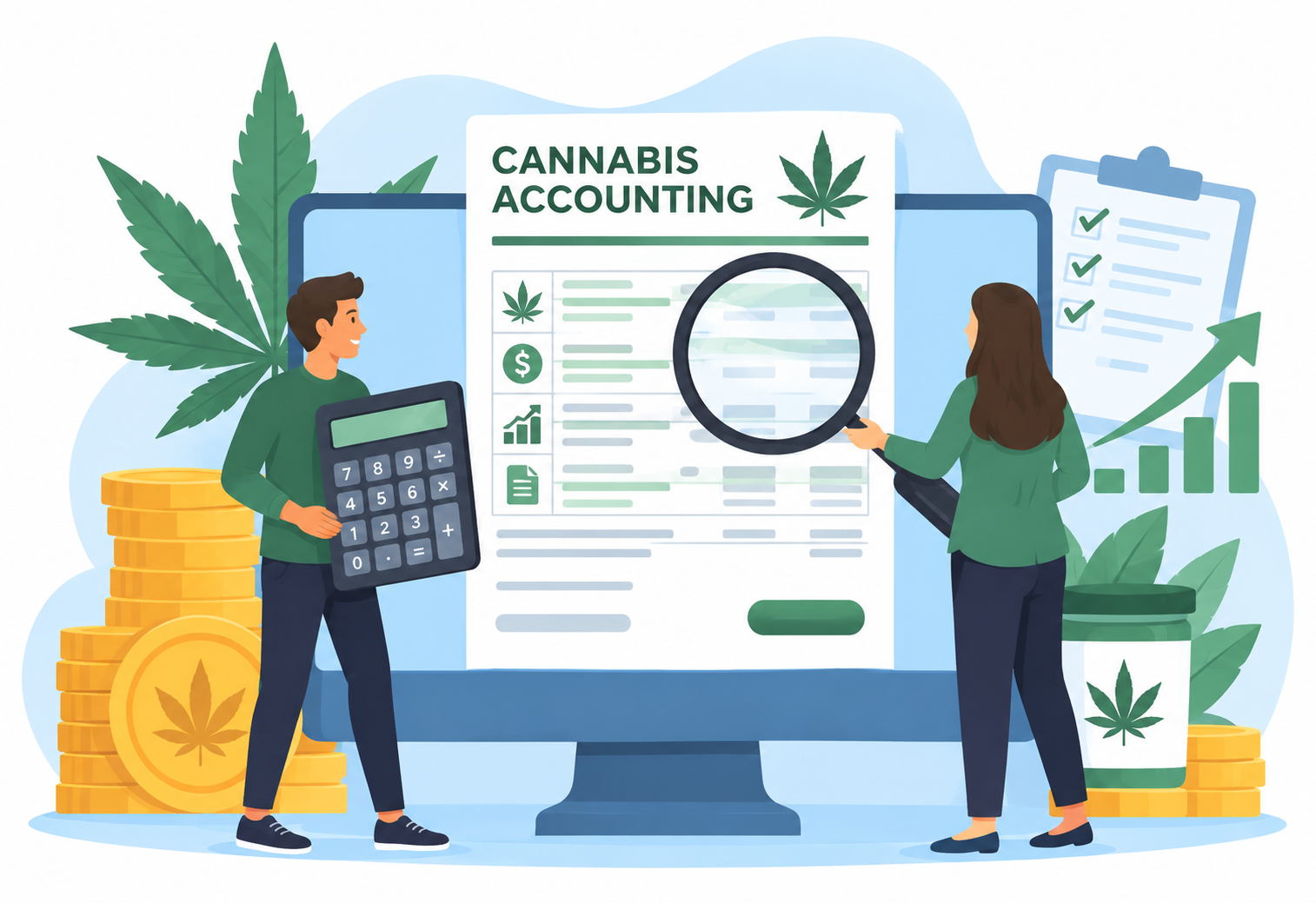
Cannabis Accounting

Cannabis Accounting, Tax & Business Advisory Services in NY US

Michael Verderosa CPA, P.C. provides Cannabis Accounting, Tax & Business Advisory Services in NY US, working with licensed operators across Suffolk County and Long Island from our Patchogue office. We handle New York 280E decoupling, excise tax filings and Office of Cannabis Management (OCM) reporting. Michael came up through BDO and in-house finance at Nature’s Bounty, and he brings that big-firm discipline to owner-operated businesses. Every engagement is quoted in writing before work starts. If we don’t give you a quote up front, you don’t pay.

At a Glance

  • Federal: IRC Section 280E still disallows ordinary business deductions for adult-use cannabis. Since April 28, 2026, marijuana handled under a state medical license is in Schedule III, which takes qualifying medical activity outside 280E.
  • New York State: Decoupled from 280E for licensed operators, effective for tax years beginning on or after January 1, 2023 (2022-2023 budget bill, signed April 9, 2022).
  • New York City: Decoupled separately for the UBT, GCT and BCT (S7508, signed November 2023), retroactive to tax years beginning January 1, 2022. This applies to businesses taxed by the city, not to Suffolk or Nassau operators.
  • Excise: Adult-use pays a 9% wholesale excise and a 13% retail excise (9% state plus 4% local). Vertically integrated operators apply the 9% to 75% of the retail price. The THC potency tax was repealed June 1, 2024.
  • Regulators: OCM and the Cannabis Control Board license and oversee operators. Excise taxes are filed with the NYS Department of Taxation and Finance, not OCM.

Not sure your last return captured the New York deductions? We can review it and tell you what, if anything, is worth amending. Book a review

Why Cannabis Accounting in New York Is Different

Federal law treats adult-use cannabis operators as if most of their expenses do not exist. New York does not. That gap between the federal return and the state return is where good accounting pays for itself, and where mistakes are expensive.

Your federal return

Under 280E, an adult-use operator can generally deduct cost of goods sold but not rent, payroll, marketing or other ordinary expenses. How you build COGS, and how well you document it, is the largest lever you have on the federal bill.

Your New York State return

New York allows licensed operators to deduct the expenses 280E disallows federally. State returns for tax years beginning in 2023 or later should reflect that. A return prepared on federal 280E logic will have left deductions on the table, and that is often correctable.

Your New York City return, if you operate in the five boroughs

New York City has its own authority to follow the federal code, so it needed its own law. S7508 lets cannabis businesses deduct ordinary expenses for UBT, GCT and BCT purposes, retroactive to tax years beginning in 2022. Long Island operators in Suffolk and Nassau are not subject to these city taxes, but anyone with a New York City location or city-source income should have that return checked.

What this means for your books

You may need one set of records that can produce a federal position, a state position and, for some operators, a city position. That is a chart-of-accounts problem before it is a tax problem. Rebuilding it after year end is slow, so we set it up correctly from the start.

Where Federal Rescheduling Stands

Headlines on this topic are often wrong, so here is the position as of late November 2026. Confirm it before relying on it for a filing, because it is moving.

Item

Status

April 28, 2026 order

Moved FDA-approved marijuana drug products and marijuana under a state medical license from Schedule I to Schedule III. Adult-use was not included.

280E

Schedule III substances fall outside 280E, so qualifying medical activity is no longer subject to it. Treasury and the IRS have said they plan to issue guidance, and it was still pending at last check.

DEA registration

DEA has begun granting registrations and issued guidance with a November 29, 2026 supply chain deadline. Some medical operators have sued over those rules.

Broader rescheduling

The DEA hearing on moving all marijuana to Schedule III has produced no recommendation, no decision and no timeline.

Adult-use today

Still Schedule I and fully subject to 280E federally. State and city decoupling still apply.


Six Things New York Cannabis Operators Ask Us For

Lorem ipsum dolor sit amet, consectetur adipiscing elit. Ut elit tellus, luctus nec ullamcorper mattis, pulvinar dapibus leo.

1. Decoupling review. A look back at state returns from 2023 and, where relevant, city returns from 2022, to confirm the New York deductions were applied and whether amended returns are worth filing.

2. Medical and adult-use split. New York registered organizations and other dual-license operators now sit under two federal regimes. Shared costs such as rent, security and management salaries have to be allocated between them, and the method you document is the method you defend.

3. Excise tax compliance. The 9% wholesale excise, the 13% retail excise and the medical gross receipts excise, filed through the Department of Taxation and Finance.

4. The 75 percent basis rule. For vertically integrated registered organizations and microbusinesses, the wholesale excise applies to 75% of the retail price. Getting the base wrong repeats the error on every sale.

5. COGS allocation. A cost of goods sold method built to hold up under examination, tied to your seed-to-sale and inventory records.

6. OCM-ready reporting. Monthly financials that reconcile inventory and cash, ready for license renewals, lenders, investors and OCM expectations.

What New York Cannabis Operators Pay

The potency tax was repealed effective June 1, 2024 and replaced with flat percentages. Pricing models built before that date are out of date.

Charge

Rate

Applies to

Wholesale excise

9%

Distributor sales of adult-use products to retailers. Registered organizations and microbusinesses selling directly to consumers apply it to 75% of the retail price.

Retail excise

13%

Adult-use retail sales (9% state plus 4% local). It takes the place of regular sales tax.

Medical excise

3.15%

Gross receipts from medical cannabis sold by registered organizations. Confirm the current rate with the Department before filing.

NYS income tax

Decoupled from 280E

Ordinary business expenses deductible for licensed operators from tax year 2023.

NYC UBT, GCT, BCT

Decoupled from 280E

Ordinary business expenses deductible, retroactive to tax year 2022.

Federal IRC 280E

Varies

Still applies to adult-use. Lifted for qualifying state-licensed medical activity since

How the Excise Taxes Add Up on a Sale

Separate distributor and retailer. A distributor sells a product to a dispensary for $40, and the dispensary sells it for $80.

Wholesale excise, 9% of $40

$3.60

Retail excise, 13% of $80

$10.40

Total cannabis excise on the product

$14.00

Vertically integrated operator. A registered organization sells a product at retail for $100.

Wholesale excise, 9% of 75% of $100 ($75)

$6.75

Retail excise, 13% of $100

$13.00

Total cannabis excise on the product

$19.75

Federal tax under 280E comes on top of both. Illustrative examples with rounded numbers, not client results.

Every New York License Type

The accounting changes with the license. A distributor carries the wholesale excise. A retailer carries the 13% and the point-of-sale reconciliation. A registered organization carries both, plus the 75% rule and a medical and adult-use split.

We work with adult-use cultivators, processors and distributors, adult-use retail dispensaries, microbusinesses, registered organizations, CAURD licensees, delivery licensees, on-site consumption licensees and multi-location operators.

NY OCM and the Cannabis Control Board

The Office of Cannabis Management (OCM) regulates medical cannabis, adult-use cannabis and cannabinoid hemp in New York. It reviews applications, inspects licensees and enforces the rules. The Cannabis Control Board sits above OCM, votes on regulations and license approvals, and meets publicly.

Why it matters for your books: a single Board vote can change fees, timelines or operating rules, and lenders and investors will ask how you are tracking them. OCM does not collect cannabis taxes. Excise returns go to the Department of Taxation and Finance.

Opening a Dispensary in New York: The Financial Steps

The entity and tax choices you make at the start are hard to undo, so the order matters.

  1. Choose your entity and tax classification with 280E in mind, and draft an operating agreement that matches the ownership on your OCM application. We handle entity setup for corporations, LLCs and DBAs.
  2. Build financial projections for your business plan: a multi-year P&L, balance sheet and cash flow, with federal tax under 280E modeled in.
  3. Document every funding source, from personal funds to investor agreements and loan term sheets, so OCM can see adequate capital.
  4. Budget for fees, build-out and compliance: application and license fees, security, insurance, payroll and seed-to-sale software.
  5. Set up 280E-ready books in QuickBooks or your platform of choice, with COGS, payroll and tax registrations separated from day one.
  6. Prepare for OCM inspections and reporting, including the financial and inventory reports a licensed operator files.

Financial Statements and Audit Readiness

Investors, lenders and buyers want more than a tax return. They expect monthly statements that reconcile inventory to your seed-to-sale records, a tax position that already reflects 280E and New York decoupling, and, for larger operators, reviewed or audited financial statements.

Multi-location operators also need reporting by store and by license so margins and cash can be compared across sites. We close the books monthly, reconcile cash and inventory, and prepare the documentation a lender, buyer or reviewer will ask for. See our audit and review services.

What We Deliver

Tax and compliance. 280E strategy and COGS allocation, state and city decoupling review, amended returns where the position supports one, excise filings, and medical versus adult-use expense segregation. Tax consulting

Accounting and bookkeeping. A chart of accounts built for your federal, state and city positions, monthly close, seed-to-sale reconciliation, inventory and cost accounting, and payroll. Bookkeeping services

Virtual CFO. Pricing and margin modeling under the post-2024 excise structure, cash flow forecasting, capital planning and lender or investor reporting. Virtual CFO services

IRS and tax resolution. Representation if a notice, audit or penalty lands on your desk. IRS resolution

ABOUT ME

Meet Michael Verderosa, Your Trusted CPA in Suffolk County, NY

At Michael Verderosa CPA, P.C., we help individuals and businesses in Mastic Beach, Patchogue, and across Suffolk County achieve financial stability through expert tax preparation, accounting, and IRS problem resolution. Our mission is simple: provide personalized solutions that make compliance easy and maximize your savings.

With 12+ years of experience in public and private accounting, Michael brings expertise from working with BDO (one of the world’s top 5 accounting firms) and Nature’s Bounty, a multi-billion-dollar corporation. This background allows us to deliver tailored tax strategies and accounting solutions for both small businesses and individuals in Long Island and New York.

Michael specializes in:

video showcase
real testimonials

What They
Say About Our
Company?

 Kim Marie Nemeth
Michael is very professional and very knowledgeable. Working with him brought immense peace of mind and security, knowing my finances were in order. He handles all my business and personal accounts. He’s my forever CPA! Price assessment Great price Services Trusts & estates accounting, Business tax return preparation, Individual tax planning
Kim Marie Nemeth
Business Owner
Jenna Glock
Michael has always been extremely helpful, trustworthy, honest, and informative. He is nothing but a pleasure to deal with and incredibly responsive. His services are invaluable. With his great knowledge and his honest character, you could not be in better hands
Jenna Glock
Business Owner
Kayla Rooney
For many years, Michael Verderosa has been my trusted accountant, consistently demonstrating exceptional professionalism and a friendly demeanor. His thoroughness and expertise make the accounting process seamless and stress-free. I highly recommend his services to anyone seeking a reliable and personable accountant.
Kayla Rooney
Business Owner
Jeff Yalden
Simply amazing! I reached out to Michael and his team years ago in desperation. He’s since relieved me of a lot of stress and got me on the right track. Highly recommend without a doubt. Love working with him and the team.
Jeff Yalden
Business Owner
contact details

Our Contacts

We’re here to help you simplify accounting and achieve financial success. Whether you need tax planning, bookkeeping, payroll, or business consulting, our team is ready to provide personalized solutions. Fill out the form below or reach us by phone or email—we’ll respond promptly and guide you every step of the way.

Our Address:

82-84 E Main St Unit 5, Patchogue, NY 11772, USA

Our mailbox:

Michael@verderosacpas.com

Our phones:

631-657-6957

GET IN TOUCH

Ready to Get Started?

Book Your Private Consultation with Michael Verderosa Online.

faq

New York Cannabis Accounting FAQs.

Do we need a cannabis-specialized CPA?

For a licensed operator, yes. Between the excise structure, the 75% rule, state and city decoupling, and a medical and adult-use split, a generalist can easily miss something. The usual result is overpaying federal tax or leaving state deductions unclaimed.

What is the 75 percent basis rule?

For vertically integrated operators, the 9% applies to 75% of the retail price. On a $100 sale that is $6.75, plus $13 of retail excise.

Does New York decouple from 280E?

Yes. The state decoupled for tax years beginning January 1, 2023, and New York City for tax years beginning January 1, 2022. Federal law still disallows the deductions for adult-use.

Can we amend prior returns?

Often. It depends on the amounts, the open tax years and your records. We quantify what is recoverable before recommending anything.

I'm on Long Island. Does the city decoupling apply to me?

Generally no. Suffolk and Nassau operators get the state decoupling. The city relief applies only to businesses taxed by New York City.

How does the April 2026 rescheduling affect me?

Medical-only licensees: qualifying activity is now outside 280E federally, though IRS guidance is pending. Adult-use remains Schedule I. If you hold both, you need a documented method for allocating shared costs.