
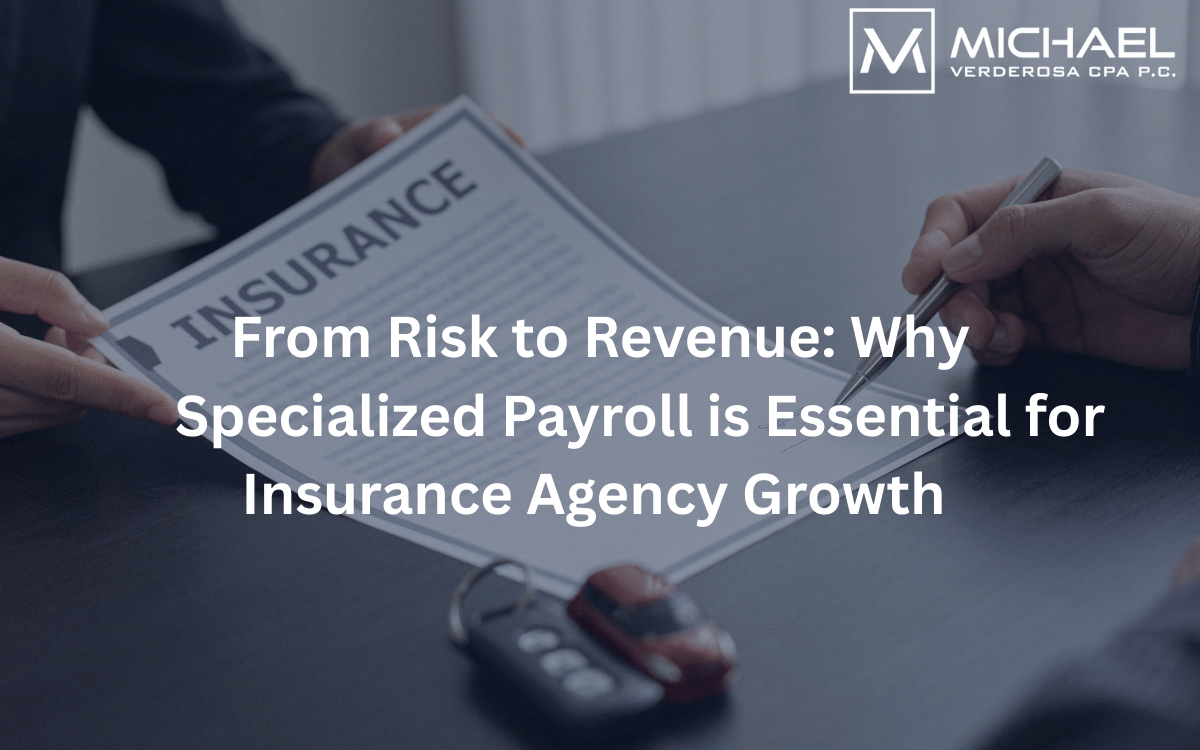
Running a successful insurance agency demands intense focus. Owners and principals juggle policy sales, client service, compliance, and marketing all while navigating the volatile waters of the insurance market. In this high-stakes environment, one back-office function often becomes a disproportionate drain on time and a source of crippling risk: payroll management.
For many agencies, payroll is mistakenly viewed as a simple calculation hours times rate. In reality, it is a complex, multi-faceted operational responsibility that includes tracking hours, calculating tiered commissions and bonuses, handling tax withholdings, ensuring multi-state compliance, filing government reports, and managing sensitive employee data securely. When handled in-house using manual spreadsheets or generic accounting software, payroll risks compliance failures, damages team morale, and directly hinders the agency’s ability to focus on revenue generation.
This guide explores why professional, specialized payroll management is not merely a convenience, but a strategic necessity for any growing insurance agency.
The Unique Payroll Complexities of the Insurance Sector
The core difficulty in agency payroll stems from its unique compensation structure. Unlike a standard retail or service business, an insurance agency must grapple with producer compensation that is rarely one-size-fits-all.
- Complex Commission Structures: Agents and producers are paid through a delicate ecosystem of base salary, upfront commissions, trailing commissions (renewals), bonuses, and tiered splits based on volume or policy type. Calculating these accurately for every agent, every pay period, is a time-intensive and error-prone process.
- Multi-State Compliance: As agencies grow, they often hire licensed producers in neighboring states. Each state maintains its own complex set of labor laws, withholding rates, unemployment insurance requirements, and even specific rules for classifying 1099 contractors versus W-2 employees. Navigating this web of regulations requires constant vigilance and specialized expertise.
- The Contractor vs. Employee Dilemma: The classification of insurance producers as either employees (W-2) or independent contractors (1099) is a frequent audit trigger. Misclassifying an employee as a contractor to avoid taxes can result in severe penalties, back taxes, and interest from federal and state agencies.
The simple fact is that general accounting knowledge does not cover the detailed, industry-specific expertise required to manage these issues seamlessly. Relying on an internal bookkeeper whose primary expertise lies outside of payroll often means the agency is exposed to unnecessary legal and financial risk.
Reclaiming Time and Focus for Revenue Generation
The most immediate and tangible benefit of outsourcing payroll is the liberation of agency leadership and staff. If the agency owner or a senior manager is spending hours manually calculating commission splits, reconciling time cards, and preparing tax deposits, they are not engaged in the revenue-generating activities that actually grow the business selling policies, client retention, and team training.
Outsourced payroll services take the entire process off the agency’s plate. This includes:
- Automated Calculations: Handling all standard and non-standard deductions, including insurance premiums, 401(k) contributions, and pre-tax health savings accounts.
- Tax Administration: Calculating, depositing, and filing all federal, state, and local payroll taxes, including quarterly 941s and annual W-2/W-3 preparation.
- Direct Deposits: Ensuring funds are distributed accurately and on time, every time, eliminating manual check cutting and reconciliation.
When an agency is small and focused on growth, every minute counts. Having dedicated support for operational tasks allows the leadership team to focus entirely on closing business and strategic planning. This strategic focus is often advised by an expert, since the strategic decision to outsource is based on maximizing professional time. For this reason, a trusted financial advisor is often necessary, and locating a specialized Insurance Accountant Services is a crucial step in ensuring that the agency’s strategic spending and financial health are optimized from the start.
Guaranteed Regulatory Compliance and Risk Mitigation
Payroll compliance is an area of absolute liability for agency owners. Errors in tax filing or payment can result in four-figure penalties, even if the mistake was unintentional. Regulatory requirements span multiple bodies: the IRS, state labor boards, the Department of Labor (DOL), and state unemployment agencies.
A professional payroll provider assumes the responsibility for staying abreast of all these constantly changing rules. They specialize in handling:
- Up-to-Date Tax Codes: Ensuring the correct withholding tables are used, regardless of the state.
- Multistate Filing: Correctly filing and depositing taxes in every jurisdiction where an agency has an employee.
- End-of-Year Documents: Accurate and timely processing of W-2s for employees and 1099s for contractors.
- Affordable Care Act (ACA) Compliance: Generating the necessary reporting forms (1095-C) for agencies that meet the size threshold.
By guaranteeing compliance, outsourcing provides peace of mind that a basic in-house system cannot. This is especially true when dealing with the intricacies of employment law and the tax implications of commissions. Furthermore, errors related to classification can attract the attention of the Internal Revenue Service. Agencies need a bulletproof approach to managing taxes. Even the smallest agency needs to be certain that its tax submissions are flawless and strategically sound. In this instance, seeking counsel from an Irs Tax Specialist who understands both federal payroll tax law and the insurance industry’s unique producer compensation structure is essential for minimizing audit risk and avoiding costly financial reassessments. This strategic oversight turns a painful administrative task into a secure, predictable function of the business.
Boosting Team Trust through Unwavering Accuracy
In an industry built on commissions and incentives, accuracy is the bedrock of trust between agency leadership and the sales team. An incorrect commission payment whether late, under-calculated, or confusingly documented can instantly erode morale, lead to frustrating disputes, and even spur valuable producers to look elsewhere.
Professional payroll management services leverage technology designed specifically to handle complex commission scenarios, ensuring:
- Flawless Payouts: Ensuring every agent receives the correct amount based on their tier, policy type, and split agreements.
- Transparent Reporting: Providing agents with easy-to-understand pay stubs and commission statements that clearly detail all earnings, deductions, and tax withholdings.
- Timeliness: Guaranteeing paychecks are delivered on time through reliable direct deposit systems.
When the payroll function is managed with professional precision, agents feel valued, their focus remains on selling, and the agency avoids the awkward, time-wasting conversations required to fix manual errors. This level of reliability is critical for retaining top talent in a highly competitive market.
Enhancing Data Security for Sensitive Information
Payroll is an administrative function that involves handling the most sensitive types of employee data: names, addresses, social security numbers, bank details, and personal tax withholding information. Running payroll through insecure internal systems, basic spreadsheets, or unsecured email communications exposes the agency to severe risks. A data breach involving this sensitive information can lead to identity theft, financial fraud, and crippling lawsuits, not to mention irreparable reputational damage.
Professional payroll providers operate using secure, encrypted, cloud-based platforms. These systems are protected by:
- Multi-Layered Authentication: Ensuring only authorized personnel can access the data.
- Data Encryption: Protecting all stored and transmitted employee information.
- Industry-Specific Security Audits: Maintaining compliance with stringent data protection standards.
By outsourcing payroll, the agency transfers the liability of maintaining high-level data security to a provider whose core business is built around it. This protects both the business and its employees from potentially catastrophic security breaches. Furthermore, while the payroll function deals with payment and security, the underlying health of the agency’s books must also be immaculate. Maintaining accurate records of all income (premiums, fees) and expenses (salaries, overhead) is crucial for accurate financial reporting. To ensure this financial groundwork is perfectly maintained, the oversight of a dedicated financial professional specializing in the daily transactions of the firm is critical. This is where services focused on Small Business Bookkeeping for the insurance sector become essential, guaranteeing that the general ledger is as accurate and compliant as the payroll itself.
Scalable Support for Growth and Expansion
The administrative burden of a solo agent is vastly different from that of a multi-location agency with dozens of producers. An in-house payroll solution often requires rebuilding the system or hiring dedicated staff every time the agency expands or adds a new state to its operations.
Professional payroll management solutions are inherently scalable. They can effortlessly support:
- New Hires: Seamlessly integrating new employees, capturing their W-4s, and setting up direct deposit.
- Multi-State Expansion: Instantly adding new state tax accounts and ensuring compliance with local requirements.
- Increased Complexity: Handling the administrative load when the agency introduces new commission tiers, bonus structures, or benefit plans.
This flexibility allows agency leadership to pursue aggressive growth strategies without worrying that the back office will become a bottleneck. The payroll system can accommodate growth from a small team of three to a regional enterprise of fifty, ensuring administrative efficiency keeps pace with sales success.
Conclusion
In the competitive and highly regulated insurance industry, excellence must extend from client-facing sales to back-office operations. Managing payroll in-house is a false economy it consumes valuable time, compromises accuracy, exposes the agency to regulatory penalties, and risks damaging the trust built with the sales team.
By turning to professional, specialized payroll management, insurance agencies gain more than just a simplified process. They secure guaranteed compliance, enhance data security, and, most importantly, free up agency principals to focus on the core competencies that truly drive profitability: cultivating client relationships, recruiting top talent, and strategically expanding the business. Letting professionals handle the intricacies of producer compensation and regulatory filing is the smart, strategic choice for any agency serious about achieving long-term success and growth.

Author
Michael Verderosa
Michael Verderosa CPA, P.C. is a trusted certified public accountant based in New York City since 2011. He provide comprehensive services including tax preparation, bookkeeping, payroll, financial statement preparation, and advisory solutions for individuals and businesses.